
Meta ships StyleX as the styling layer behind very large surfaces, not because CSS is broken, but because classic runtime CSS-in-JS struggles to scale when huge component trees and variant matrices meet strict performance budgets.
The bet is simple to state and hard to execute: move styling work off the main thread’s long tail and into the bundler, so the browser mostly loads deterministic static CSS and applies atomic class names instead of synthesizing rules on every navigation and interaction.)
What goes wrong with runtime CSS-in-JS
Many CSS-in-JS libraries ask the runtime to:
- Execute style functions or objects when components render.
- Serialize declarations into strings or hashes.
- Inject new rules into
<style>tags or a stylesheet registry during hydration and updates.
That model is ergonomic for product teams: colocation, themes, dynamic props. It also carries costs:
- JavaScript time on meaningful render paths for style resolution.
- Larger bundles for runtime helpers.
- Harder caching and deduplication when rules appear late or per app.
- Inconsistent injection strategies across repos and micro-frontends.
At Meta-scale codebases, those margins compound.
How StyleX reframes the problem
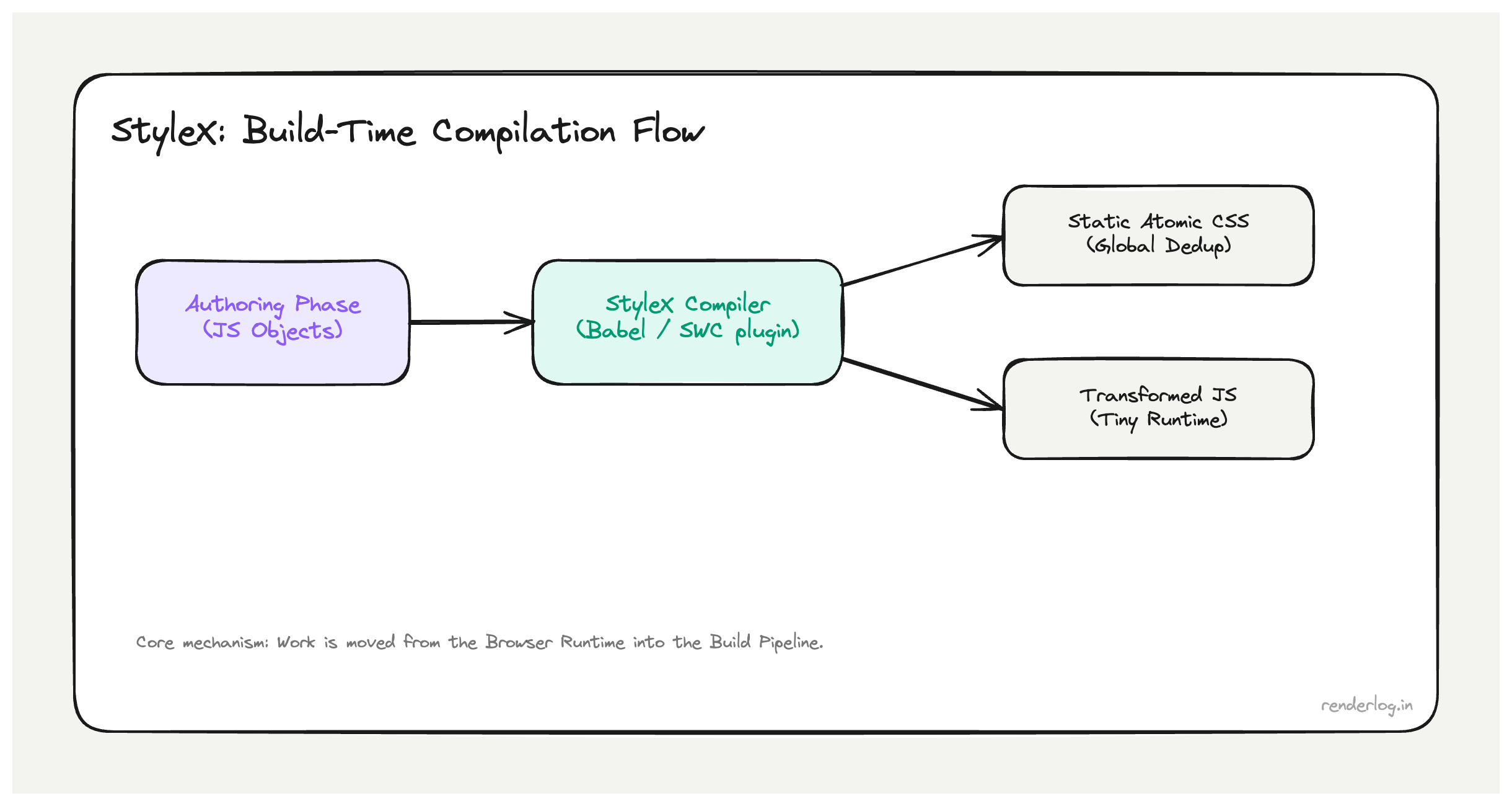
StyleX keeps the authoring surface in JavaScript (objects analyzed by a compiler) but does not treat the browser as the first place styles materialize. A compiler plugin runs at build time and:
- Statically reads style definitions tied to components.
- Emits atomic classessmall, reusable rules so duplicates collapse globally.
- Writes plain CSS files or chunks the document loads like any other static asset.
Atomic CSS is the mechanical trick that makes dedup cheap: many call sites reuse the same small declaration set instead of generating nearly identical rules at runtime.
The StyleX documentation is the source of truth for API details and constraints; this post stays at architecture level.
Runtime vs build time (one table)
| Phase | Classic runtime CSS-in-JS | StyleX |
|---|---|---|
| Authoring | JS objects / tagged templates | JS objects (build-time analyzable) |
| When CSS exists | During render / effects | After compile, before deploy |
| Delivery | Injected rules + runtime | Static CSS files + class names |
| Dedup | Per session / heuristic | Global, at bundle time |
| Cost | JS + injection + recalculation | Mostly parse + apply in the CSS engine |
Caveat: StyleX still ships a small runtime for conditional composition and debuggingthe win is vastly smaller than fully dynamic injection pipelines, not literally zero bytes of JS.
Why “compile time” is the headline
Frontend performance arguments often start with bundle size and end with main-thread contention. Moving styling to build time:
- Shrinks what must execute after load for style synthesis.
- Turns CSS into cacheable assets (CDN, HTTP cache, preload).
- Aligns design systems with static analysis: lint rules, dead-code elimination, predictable class inventory.
The key idea is the one you sketched: push work left on the timelinefrom runtime discovery to build extractionso production pays less per paint.
Takeaway
StyleX is Meta’s bet that large teams still want CSS-in-JS ergonomics without paying continuous runtime tax. Compilers extract styles, atomic classes deduplicate output, and static CSS restores predictable behavior for enormous trees. Not every app needs that machinery; when injection cost shows up in profilers, compile-time styling is the lever they chose.