
If you have dropped a Lottie into a loader or success screen, often via LottieFiles, you already know the DX. The interesting question is why the format exists. GIF and video exports win on “just play this clip” simplicity but tend to lose on payload, sharp scaling, and runtime control when product teams iterate weekly.
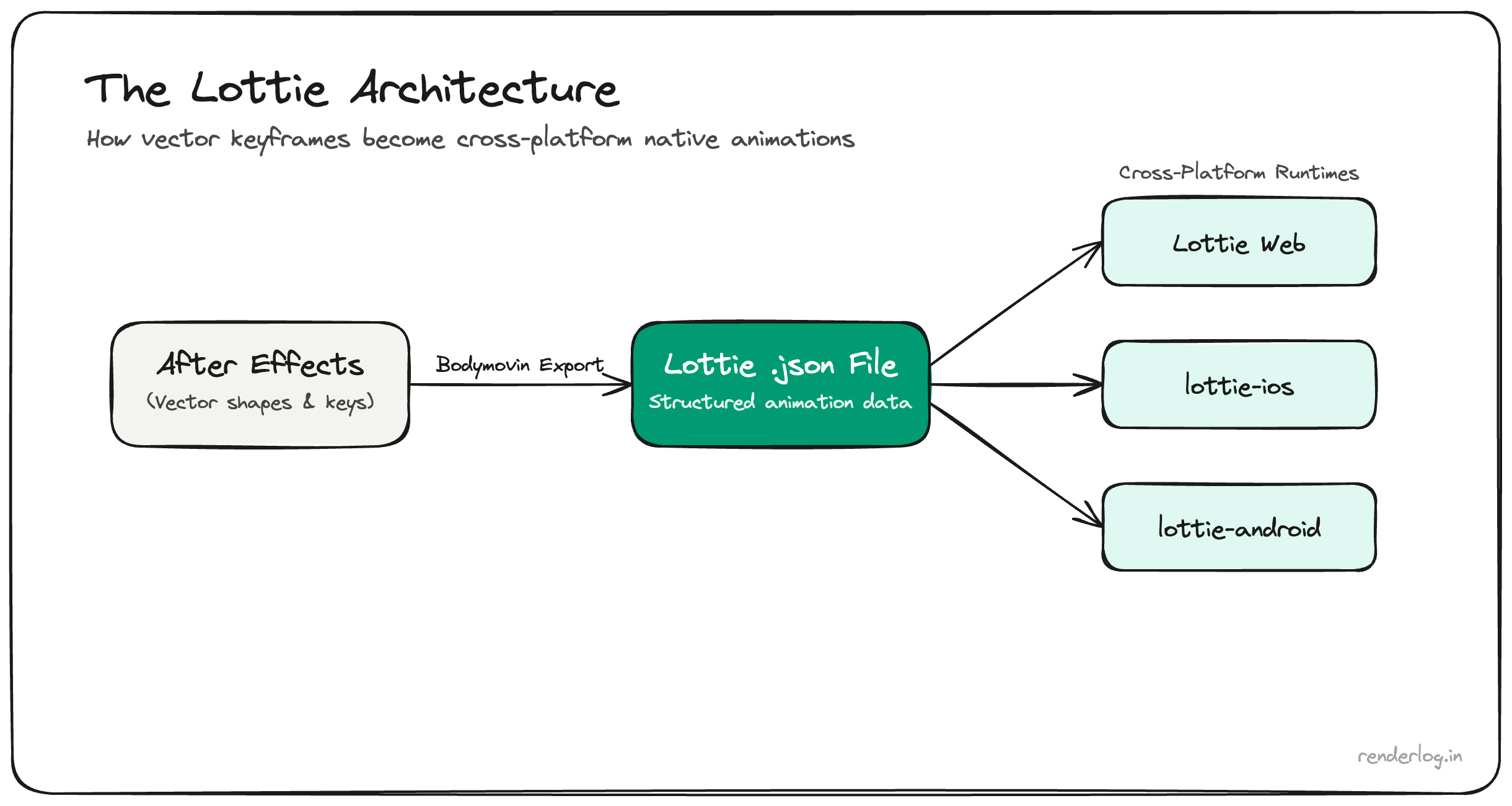
Airbnb open-sourced Lottie to keep designers in After Effects while engineers ship the same timeline as structured JSON, interpreted by thin runtimes on web, iOS, and Android. This post is architecture-level context, not a step-by-step export guide.
What hurts about GIF and video in product UI
Raster loops ship complete frames (or heavy compression). Typical pain:
| Issue | Why teams feel it |
|---|---|
| Payload | Short clips still cost noticeable KB to MB each; multiply by screens and locales. |
| Scaling | Bitmaps soften or artifact when stretched across densities and dynamic layouts. |
| Control | Speed, direction, segment playback, and theming often mean re-exporting, not toggling parameters. |
| Motion policy | Respecting reduced motion and design tokens is harder when the pixel buffer is fixed. |
For micro-interactions, those taxes accumulate.
How Lottie reframes the problem
Lottie serializes vector shapes, layers, masks, and keyframes into JSON that a runtime knows how to interpret. Playback happens in-app via Lottie Web, lottie-android, lottie-ios, or framework wrappers (React Native, Flutter, etc.).
Classic designer workflow:
- Animate in Adobe After Effects.
- Export with Bodymovin or the official Lottie exporter (names and capabilities evolve with plugin versions).
- Ship the
.jsonwith the app bundle or from a CDN.
Engineers get structured motion: seek, loop ranges, speed, dynamic properties, and optional image slots within whatever the chosen runtime supports.
LottieFiles (a separate company today) hosts marketplace assets and tooling that made the format easy to discover; the spec and open-source players trace to Airbnb’s release. Current references: lottie on Airbnb’s site: and LottieFiles.
Why JSON plus vector wins
- Often smaller than comparable frame-based loops for typical UI motion (always benchmark your own asset).
- Resolution-independent because paths re-rasterize cleanly at any size.
- One artifact across stacks when you avoid exotic AE features your runtime does not implement.
Reality check: not every After Effects feature maps one-to-one. Complex effects, some blends, and heavy expressions still force simplification or raster fallbacksplan validation in target runtimes.
Takeaway
Lottie exists because teams wanted motion design without shipping dumb pixels per breakpoint. Declarative animation data plus portable runtimes beat raster clips when you need scale, theming, and iteration speed. When your loader is JSON. The tangible win is control: the same asset on many surfaces, tunable without spinning up a fresh video encode pipeline for every tweak.